A Lycozer Syrup enquiry is only useful after you know who will manufacture and pack it, which legal category applies, and what formula is being quoted. By the end, you will have a practical checklist for comparing Panchkula suppliers, requesting a compliant quotation, checking the product dossier, and avoiding delays caused by unclear specifications.
Key takeaways
- Ask for the production site address and Form 20B licence copy.
- Confirm the formula, legal category, label claims and intended use in writing.
- Approve bottle, closure, filling volume, batch coding and quality records.
- Compare quotations with testing, documentation, lead time and release responsibility included.
Who actually manufactures and releases the Lycozer Syrup batch?
The Panchkula contact may be a manufacturing site, contract manufacturer, loan-licence coordinator, distributor, or PCD marketing supplier. Do not treat a sales office as a Lycozer syrup manufacturer until the production site is identified.
Ask for:
- The full legal name and address of the premises that will compound, fill, label and pack the syrup
- The current manufacturing licence, including the product category and liquid dosage-form permission
- The product permission or approved product list covering the proposed formula
- GMP evidence tied to that manufacturing site, not only a generic ISO or “WHO-GMP” brochure
- A recent, batch-specific certificate of analysis showing the tested product and batch number
A registered office in Panchkula does not prove that production occurs there. A company offering third party pharma manufacturing in Panchkula may outsource the batch to a plant in another state.
The quotation and quality agreement must name the licence holder, brand owner, batch-release authority, and plant responsible for deviations, complaints and recalls. If the syrup is intended for India, obtain the exact composition and claims, then determine whether it follows the drug route or the FSSAI food-supplement and nutraceutical route.
Do not classify it from “syrup,” the Lycozer name, or a brochure claim alone. A supplier unable to identify the actual manufacturing premises is not yet a qualified supplier.
How to move from an enquiry to a confirmed production order
A written enquiry gives a Lycozer syrup supplier enough information to price the job accurately. For Lycozer syrup for third party pharma manufacturing in Panchkula, state the required formula, strength per 5 ml, liquid dosage form, 200 ml pack, target market, label language, expected annual volume and delivery location.
1. Request a quotation with separate lines for formulation or development, bottles, caps, seals, labels, cartons, testing, freight, taxes, artwork changes and unused printed packaging.
2. Confirm the minimum order quantity, available batch sizes, planned production slot, packaging-material lead time, testing and batch-release time, and repeat-order timeline. Ask whether a small pilot batch is available and whether the next batch can reuse the approved formula and artwork without another development cycle.
3. Require this sequence in writing: formulation confirmation, document review, quotation approval, artwork proof, purchase order, raw-material procurement, compounding, filling, packing, testing, certificate-of-analysis review and dispatch.
4. Record schedule risks, including a new label, custom bottle or cap, low-volume batch, imported ingredient, failed test, line-cleaning requirement or production backlog.
5. Put the approved formula, 200 ml pack configuration, delivery date and rejection terms in the purchase order. Do not rely on a phone quotation; the signed order should define who pays for rejected stock, unused packaging and artwork errors.
What formula, legal category and usage information must be documented?
A Lycozer syrup supplier must provide the formula in measurable terms, not just a front-label claim. The brand name does not prove a standard composition, so obtain these records before comparing a Lycozer syrup manufacturer.
1. Request a Supplement Facts-style composition table listing every vitamin, mineral and the lycopene quantity, with the serving basis stated clearly, such as per 5 ml. Obtain the complete ingredient declaration, including the sweetener supporting the sugar-free claim, preservative, flavour, colour and every other excipient.
2. Confirm whether 200 ml is the only pack size. Record the dosage form, intended age group, serving volume, measuring cup or spoon, maximum daily use and minimum age.
3. Confirm the legal route: food, nutraceutical or drug. For food or nutraceutical products, review the FSSAI licence details, permitted ingredient use and label statements under the applicable health-supplement and nutraceutical rules. For a drug, verify the state or central drug manufacturing permission and required drug-label particulars.
4. Obtain pregnancy and breastfeeding warnings, allergen declaration, contraindications and storage instructions. Do not treat a vitamin or antioxidant claim as permission to state that the product treats or cures a disease.
5. Approve the final artwork before printing. Check the batch number, manufacturing date, expiry date, net volume, licence details, ingredient quantities, directions and warnings against the approved specification. Keep the signed artwork with the purchase records.
Which bottle, closure and quality records should you approve?
Approve the container-closure system before approving the quotation, because a low-cost bottle can still leak, shed extractables or deliver an inaccurate dose.
| Bottle option | Main consideration | Approval question |
|---|---|---|
| Amber PET | Reduces light exposure without glass breakage | Does it remain compatible with the formula throughout shelf life? |
| Clear PET | Easier visual inspection but higher light exposure | Does stability data support the formula in clear packaging? |
| Glass | Strong barrier and light protection when amber, but heavier and breakable | Has transport testing covered breakage and closure integrity? |
Specify the cap, liner, induction seal or other tamper-evident feature, label stock, carton and 5 ml measuring cup or spoon. Ask for evidence covering leakage, compatibility, sorption, extractables, cap torque, dose-measurement variation and transport damage. A syrup manufacturer in Panchkula should show these results for the proposed bottle, closure, measuring device and seal.
Require a finished-product specification listing assay of active ingredients, pH, viscosity, specific gravity or density, fill volume, microbial limits and preservative content where applicable. For a multidose aqueous syrup, request preservative-efficacy or antimicrobial-effectiveness evidence; detecting a preservative does not prove protection after opening.
Request stability data for the exact formula, bottle, closure and process, stating shelf life, storage conditions and in-use period after opening. Confirm whether accelerated testing uses 40°C ± 2°C/75% RH ± 5% RH and long-term testing uses 30°C ± 2°C/75% RH ± 5% RH when those conditions apply to the selected regulatory route.
Each dispatch from a third party pharma manufacturing in Panchkula arrangement should include a batch-specific certificate of analysis, packing details and retention-sample records.
How should you compare a Panchkula supplier before signing?
Compare documented capability, not the lowest per-bottle price. For lycozer syrup for third party pharma manufacturing in panchkula, score the premises that will actually manufacture, test and release the batch, not the Panchkula sales office.
| Check | Evidence to request | Risk if absent |
|---|---|---|
| Licensed site | Current licence, full plant address and product permission | Production may occur elsewhere or outside the licence |
| Liquid capacity | Line size, batch-size range and manufacturing calendar | Your launch date may be unrealistic |
| Cleaning controls | Cleaning procedure, validation record and changeover controls | Carryover or contamination can affect the next batch |
| Laboratory testing | Finished-product specification, test methods and batch-specific certificate of analysis | You cannot verify release quality |
| Release time | Written testing and batch-release timeline | Stock can remain held after filling |
| Packaging sourcing | Bottle, cap, seal, label and carton suppliers; unused-stock terms | Artwork changes can create hidden costs |
| Freight arrangements | Dispatch point, carrier, breakage liability and delivery terms | A nearby quote can still carry interstate freight |
| Quality systems | Complaint, deviation, recall and change-control procedures | Responsibility becomes disputed after a failure |
Ask the syrup manufacturer in Panchkula to put these terms in a quality agreement:
- Sampling, out-of-specification results, deviations, recalls, audit rights and retention samples.
- Destruction or return of rejected stock, including who pays for a failed batch or artwork error.
- Product-approval ownership, batch-release responsibility and permission to manufacture under another company’s approval.
A lycozer syrup supplier may be only a distributor or PCD marketing coordinator. Verify the actual plant and calendar, even if meetings occur in Panchkula. Linco Healthcare Pvt. Ltd. can be assessed as a Panchkula-based contact, using the same licence, composition, stability, quotation and release checks.
Sign only when those details match across the quotation, licence, agreement and certificate of analysis.
Related product
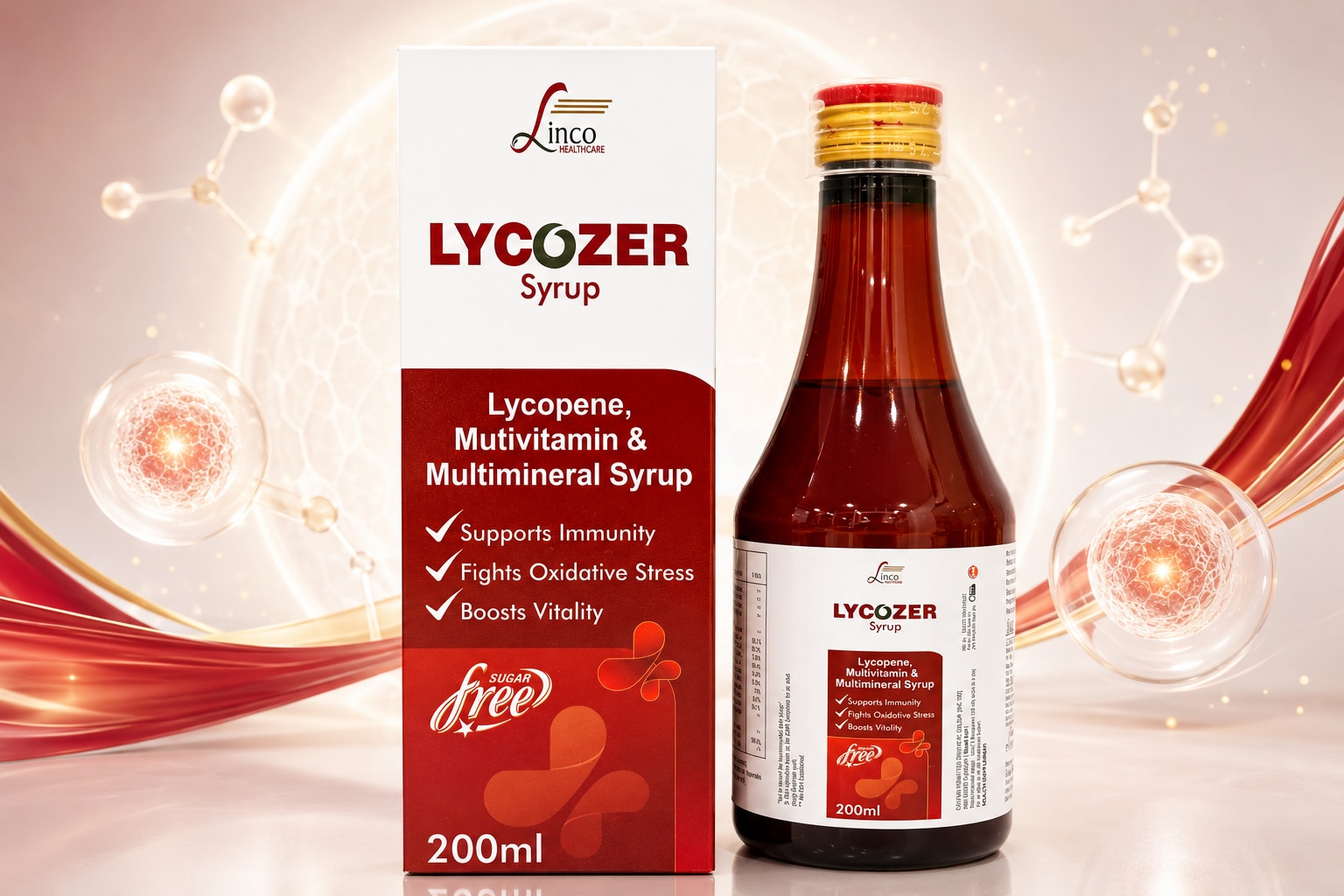 | Syrups Lycozer Syrup is a sugar-free nutritional formulation enriched with Lycopene, multivitamins and multiminerals. View product → |
Frequently asked questions
Who actually manufactures and releases the Lycozer Syrup batch?
Identify the production site, licence holder and batch-releasing company. Ask for the site address, Form 20B manufacturing licence copy, agreement details and the name responsible for quality release. A sales office, distributor or PCD marketing supplier is not automatically the manufacturer.
How do I move from an enquiry to a confirmed Lycozer Syrup production order?
Send the required quantity, pack size, delivery location, artwork status and target date. Obtain a written quotation, product specification, minimum order quantity, payment terms, lead time and testing scope. Confirm the purchase order only after approving the formula, label, packaging and release documents.
What formula, legal category and usage information must be documented?
Record every active ingredient and quantity per 5 mL, excipients, flavour, colour, dosage form, intended use, warnings, storage statement and shelf life. Confirm whether the product is regulated as a drug, nutraceutical or another category, then align the label and licence documents with that classification.
Which bottle, closure and quality records should I approve?
Approve the bottle material, nominal volume, fill volume, neck finish, cap or child-resistant closure, induction seal, label dimensions and outer carton. Request the product specification, certificate of analysis, batch manufacturing record, packing record, stability or shelf-life basis and finished-product test results.
How should I compare a Panchkula supplier before signing?
Compare the verified manufacturing site, licence status, formulation control, packaging samples, minimum order quantity, lead time, testing, batch-release responsibility, complaint handling and total delivered cost. Treat a low quotation as incomplete until it includes documentation, quality testing and agreed release terms.
Keywords